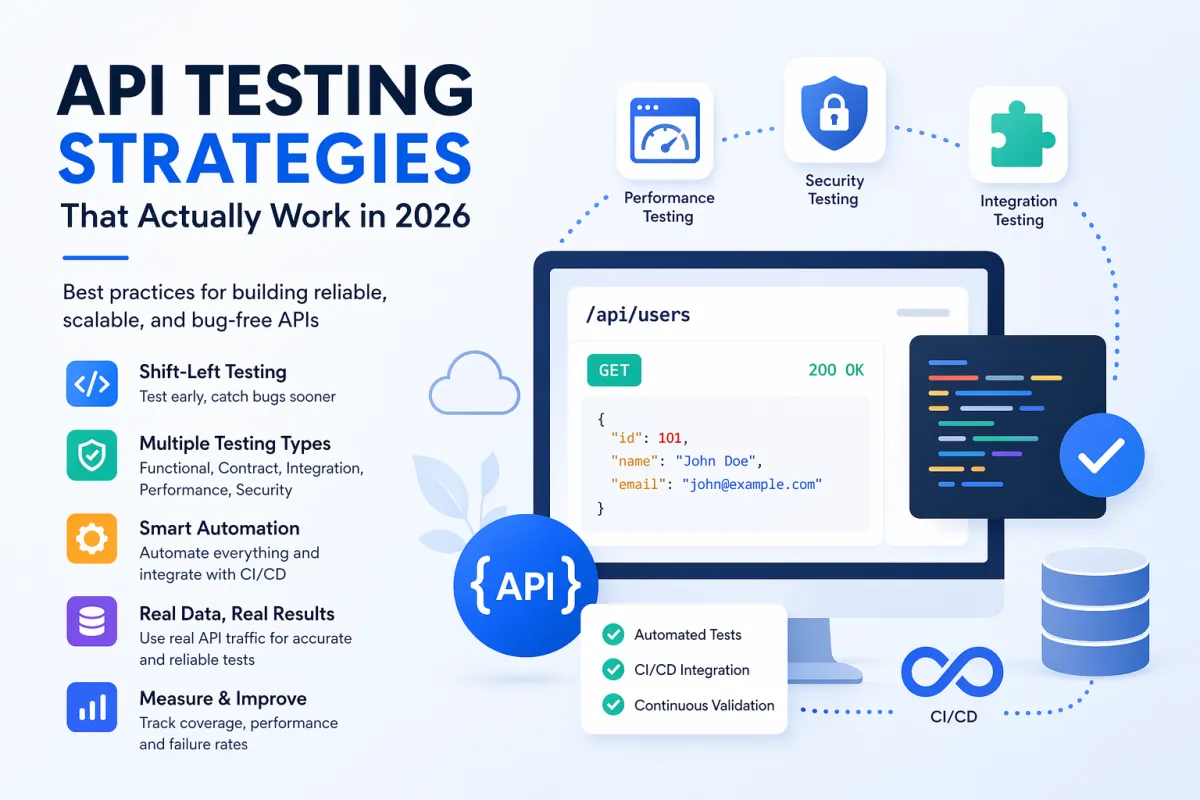
API Testing Strategies That Actually Catch Production Bugs in 2026
-

- by mikeross,
- April 21, 2026
- in technology,
In 2026, most engineering teams believe they have “solid” API testing in place. Unit tests pass. Integration tests run in CI. Everything looks green—until production breaks. The truth is uncomfortable: traditional API testing strategies are no longer enough for modern, distributed systems.
If your APIs interact with microservices, third-party integrations, asynchronous workflows, or real user data, then your current testing approach is likely missing real-world failure scenarios.
This guide explores modern API testing strategies that actually catch production bugs—and how teams are evolving beyond outdated testing methods.
Why Traditional API Testing Falls Short
Most teams still rely on:
-
Static test cases
-
Mocked responses
-
Limited edge-case coverage
While these approaches are useful, they fail in real-world scenarios because:
-
Mocks don’t reflect real production behavior
-
Test data is too clean and predictable
-
Edge cases are underestimated
-
Service dependencies behave differently in production
For example, a payment API might pass all tests with mocked success responses—but fail when a third-party provider returns delayed or malformed data.
The Shift: From Synthetic Testing to Real-World Simulation
Modern API testing is shifting toward real-world simulation instead of artificial test environments.
This means:
-
Using real production traffic patterns
-
Testing against actual API responses
-
Simulating real user behavior
Instead of asking:
“Does this API return 200 OK?”
You should ask:
“Does this API behave correctly under real production conditions?”
Strategy 1: Replay Real API Traffic
One of the most effective ways to catch production bugs is by replaying real API calls.
Why it works:
-
Captures actual user behavior
-
Includes real edge cases
-
Eliminates guesswork in test creation
Instead of writing hundreds of test cases manually, you can:
-
Record API traffic
-
Convert it into test cases
-
Replay it in CI pipelines
This ensures your tests reflect reality—not assumptions.
Strategy 2: Eliminate Over-Reliance on Mocking
Mocking is useful—but dangerous when overused.
The problem:
Mocks create a “perfect world” where:
-
APIs always respond correctly
-
Dependencies never fail
-
Data is always structured
The solution:
-
Use mocks only for unit-level isolation
-
Use real responses for integration testing
-
Introduce failure scenarios intentionally
Strategy 3: Shift-Right Testing (Production Validation)
Testing shouldn’t stop at staging.
Modern teams embrace shift-right testing, which means:
-
Observing API behavior in production
-
Validating real user flows
-
Continuously learning from failures
This includes:
-
Monitoring API responses
-
Logging edge cases
-
Feeding production issues back into tests
Strategy 4: Contract Testing for Microservices
In microservices architecture, APIs constantly interact with each other.
Contract testing ensures:
-
Services agree on request/response formats
-
Changes don’t break dependencies
Without contract testing:
-
A small API change can break multiple services
Strategy 5: Automate Everything (But Smartly)
Automation is not just about running tests—it’s about running the right tests.
Modern API automation should:
-
Run on every commit
-
Use dynamic test data
-
Adapt to changes automatically
Avoid:
-
Hardcoded test cases
-
Static assertions
Focus on:
-
Behavior-driven validation
-
Real data validation
Strategy 6: Use AI-Powered Testing Tools
AI is transforming API testing by:
-
Generating test cases automatically
-
Detecting anomalies
-
Learning from production failures
Tools like Keploy are leading this shift by enabling:
-
Automatic test generation from API calls
-
Real data replay
-
Zero manual test maintenance
This allows teams to:
-
Reduce test creation time
-
Increase coverage
-
Catch real bugs before production
Strategy 7: Test for Failure, Not Just Success
Most tests validate success scenarios:
-
200 OK
-
Expected response
But real systems fail in unexpected ways.
You should test:
-
Timeouts
-
Partial failures
-
Invalid data
-
Dependency failures
Because:
APIs don’t break when everything works—they break when things go wrong.
Strategy 8: Continuous Feedback Loop
Modern API testing is not a one-time activity.
It’s a loop:
-
Capture production behavior
-
Convert into tests
-
Run in CI/CD
-
Detect issues
-
Improve tests
This creates a self-improving testing system.
The Future of API Testing
API testing is moving toward:
-
Real-time validation
-
Autonomous test generation
-
Production-driven testing
Teams that adopt these strategies:
-
Ship faster
-
Break less
-
Gain confidence in releases
Teams that don’t:
-
Keep chasing bugs after deployment
Final Thoughts
If your API tests are only passing in CI but failing in production, the issue isn’t your code—it’s your testing strategy.
Modern API testing requires:
-
Real data
-
Real scenarios
-
Real validation
And most importantly:
-
A shift in mindset
Stop testing what should happen.
Start testing what actually happens.
If you want to build a modern API testing workflow using real API traffic and automation, explore platforms like Keploy to bring production-grade testing into your development process.
0 Comments:
Leave a Reply