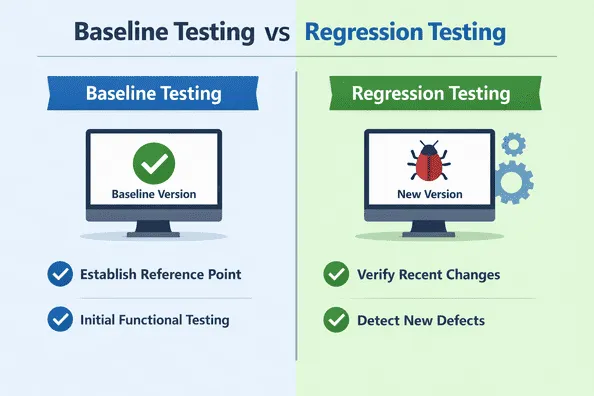
Baseline Testing vs Regression Testing: Where Each Fits in Modern QA
-

- by sophie.lane,
- February 09, 2026
- in technology,
As software teams release faster and systems grow more interconnected, testing strategies must evolve beyond one-size-fits-all approaches. Two techniques that often get confused or misused are baseline testing and regression testing. While they may look similar on the surface, they solve very different problems.
Understanding how baseline testing in software testing differs from regression testing helps teams reduce risk, avoid wasted effort, and make better release decisions in modern QA environments.
Why This Comparison Matters Today
In traditional release cycles, teams had time to run broad test suites and manually analyze results. Modern QA operates under very different conditions:
-
Frequent releases
-
Continuous integration and deployment
-
Microservices and APIs
-
Constant code and configuration changes
In this context, using the wrong testing approach at the wrong time leads to noise, slow feedback, and missed defects. That’s why clearly separating baseline testing from regression testing is no longer optional.
What Baseline Testing Actually Means in Practice
Baseline testing in software testing focuses on establishing a stable reference point for system behavior at a specific moment in time.
Instead of asking “Did something break compared to the last build?”, baseline testing asks:
-
“What does correct behavior look like right now?”
-
“Can we trust this version as a stable foundation?”
When a Baseline Is Created
A baseline is typically established:
-
After a major feature release
-
Before large-scale refactoring
-
When migrating platforms or infrastructure
-
Before onboarding new automation or tools
Once created, this baseline becomes a trusted benchmark against which future changes are evaluated.
What Baseline Testing Validates
Baseline testing verifies:
-
Core system functionality
-
Known critical workflows
-
Expected outputs and behaviors
-
Performance characteristics at a known-good state
The goal is not broad coverage, but high confidence in stability.
What Regression Testing Is Designed to Do
Regression testing focuses on detecting unintended side effects caused by new changes.
Every time code is modified, regression testing answers one key question:
-
“Did this change break something that used to work?”
Unlike baseline testing, regression testing is:
-
Continuous
-
Iterative
-
Closely tied to code changes
Typical Regression Triggers
Regression testing is commonly triggered by:
-
Bug fixes
-
Feature additions
-
Dependency updates
-
Configuration changes
In modern QA, regression tests often run automatically as part of CI/CD pipelines.
Key Differences Between Baseline and Regression Testing
Although both aim to reduce risk, their intent and timing are very different.
Purpose
-
Baseline testing establishes a trusted reference state
-
Regression testing detects deviation from expected behavior after changes
Frequency
-
Baseline testing is performed selectively
-
Regression testing runs frequently, often on every commit or build
Scope
-
Baseline testing focuses on critical, stable behavior
-
Regression testing covers a wider range of previously validated functionality
Signal Quality
-
Baseline testing produces strong, high-confidence signals
-
Regression testing produces continuous change-detection signals
Understanding these differences helps teams avoid misusing one as a substitute for the other.
Where Baseline Testing Fits in Modern QA
Baseline testing in software testing plays a strategic role rather than an operational one.
Before Major Transitions
Teams often rely on baseline testing before:
-
Large refactors
-
Architecture changes
-
Cloud or platform migrations
The baseline acts as a safety net, making it easier to identify whether changes introduce unexpected shifts in behavior.
Supporting Confident Refactoring
Without a trusted baseline, refactoring becomes risky. Baseline testing allows teams to:
-
Compare pre-change and post-change behavior
-
Validate that core functionality remains intact
-
Detect subtle regressions that unit tests may miss
Reducing False Alarms
By anchoring expectations, baseline testing reduces noise from flaky or misconfigured tests. Teams know what “good” looks like before change begins.
Where Regression Testing Fits Best
Regression testing shines in day-to-day development workflows.
Continuous Feedback in CI/CD
Regression tests provide fast signals that help teams:
-
Catch defects early
-
Prevent broken builds from progressing
-
Maintain confidence in frequent releases
Protecting Existing Functionality
Regression testing ensures that:
-
Bug fixes don’t introduce new bugs
-
Features added today don’t break features shipped yesterday
-
System behavior remains consistent over time
Scaling With Automation
Regression testing scales well with automation. As systems grow, automated regression suites become essential for maintaining coverage without slowing delivery.
Common Mistakes Teams Make
Many QA issues stem from confusing these two approaches.
Treating Regression Testing as a Baseline
Running regression tests without a trusted baseline often leads to:
-
Unclear failures
-
Disputes over expected behavior
-
Time wasted diagnosing false positives
Overusing Baseline Testing
Baseline testing is not meant for every release. Creating baselines too frequently:
-
Increases maintenance cost
-
Slows feedback loops
-
Dilutes the value of the baseline itself
Ignoring Context
Modern QA requires situational awareness. Using the right testing approach depends on:
-
Type of change
-
Risk level
-
System maturity
-
Release urgency
How Mature Teams Use Both Together
High-performing teams don’t choose between baseline testing and regression testing. They use both intentionally.
A common pattern looks like this:
-
Establish a baseline after major milestones
-
Use regression testing for continuous change detection
-
Revisit the baseline when system behavior fundamentally shifts
This layered approach improves confidence without sacrificing speed.
Final Thoughts
Baseline testing and regression testing serve different but complementary roles in modern QA. Baseline testing in software testing provides stability and trust during major transitions, while regression testing protects against everyday risks introduced by constant change.
Teams that understand where each fits move faster with fewer surprises. Instead of running more tests, they run the right tests at the right time—and that’s what truly improves software quality.
0 Comments:
Leave a Reply